If you’ve ever opened a text or seen a random “NVM” pop up in a chat and paused for a second wondering what it means—you’re definitely not alone. The quick answer is simple: NVM stands for “Never Mind.” It’s one of those everyday slang shortcuts people use when they want to drop a question, cancel what they just said, or move on from a topic without overexplaining.
You’ll run into this slang everywhere—text messages, TikTok comments, Snapchat streaks, Instagram DMs, and basically any place where people are chatting fast. It’s short, casual, and saves time, which is exactly why it shows up so often in online conversations.
Most people search for “NVM meaning” right after seeing it in a message where the context isn’t super clear. Sometimes it looks confusing at first, especially if you’re not used to internet slang.
Once you understand what it means and how people use it, though, it becomes one of the easiest and most useful texting abbreviations to recognize in everyday digital conversations.
NVM Meaning in Text
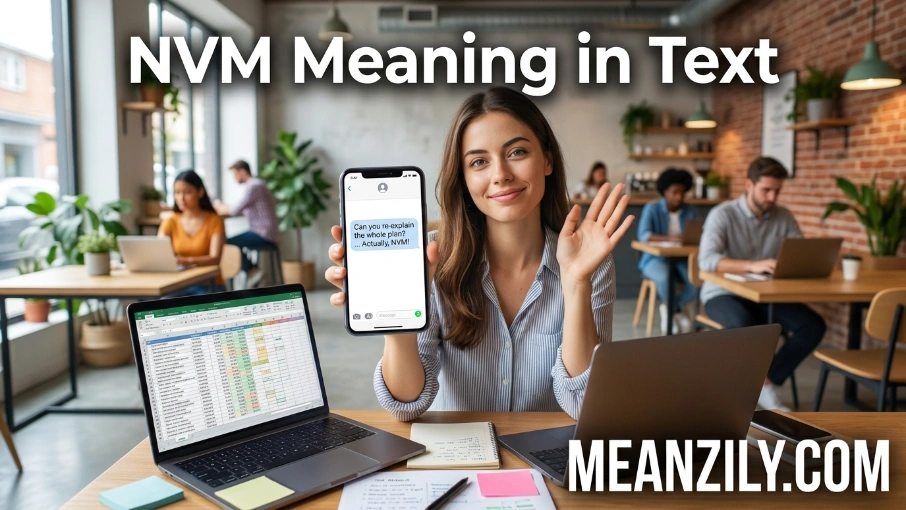
NVM means “Never Mind.”
It is a popular internet abbreviation used when someone no longer needs an answer, wants to drop a topic, or realizes they have already found the information they were looking for.
For example:
“What time does the movie start?”
A few minutes later:
“NVM, I found it.”
In this situation, the person is saying, “Never mind. I already got the answer.”
Is NVM an Acronym or Abbreviation?
NVM is generally considered an abbreviation of the phrase “Never Mind.”
Unlike some internet terms that form a new word, NVM simply shortens an existing phrase by using its key letters.
What Does NVM Mean in Everyday Chat?
In regular conversations, NVM can mean:
- Forget what I said
- It doesn’t matter anymore
- I figured it out
- Ignore my previous message
- The issue is resolved
The exact meaning depends on the context, but it almost always signals that the person wants to move on from a topic.
Where People Use NVM
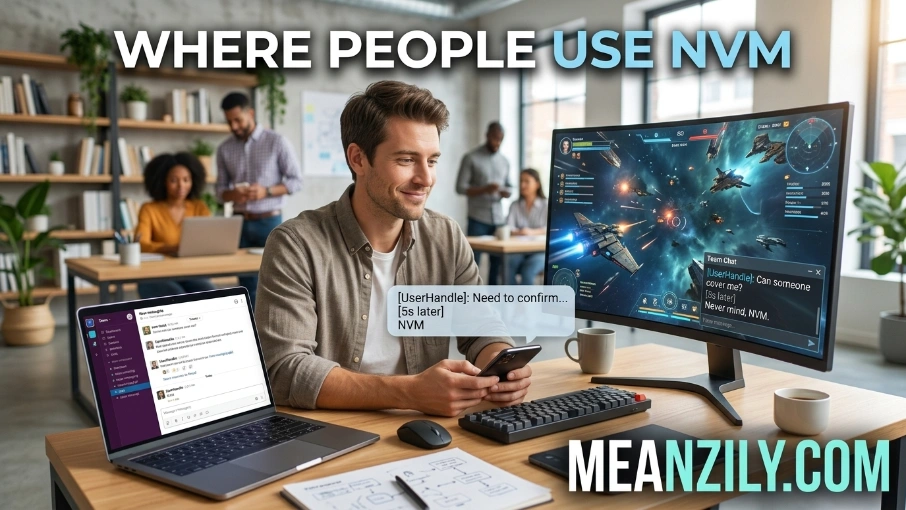
NVM appears across many digital platforms because it is short, convenient, and widely understood.
NVM on TikTok
On TikTok, users often write NVM in comments after realizing they misunderstood a video.
For example:
“Wait, is this real? NVM, I watched the whole video.”
People also use it when correcting themselves in comment threads.
NVM on Snapchat
Snapchat conversations move quickly, so abbreviations are common.
Someone might ask a question and then send:
“NVM lol”
This tells the other person they no longer need a response.
NVM on Instagram
Instagram users frequently use NVM in direct messages and comments.
It may appear when someone notices an answer in a post caption after already asking about it.
NVM on WhatsApp
WhatsApp users often use NVM in group chats and private messages.
Example:
“Can someone send me the meeting link?”
A minute later:
“NVM, found it.”
NVM in SMS Text Messages
Traditional text messaging is one of the oldest places where NVM became popular.
Because texting originally had character limits, abbreviations like NVM helped people communicate more efficiently.
Real Chat Examples
Below are realistic examples showing how NVM is used in everyday conversations.
Example 1
A: Do you know where my headphones are?
B: Which pair?
A: NVM, they were on my desk.
Example 2
A: What time is class tomorrow?
B: I think 9 AM.
A: NVM, I checked the schedule.
Example 3
A: Did you finish the project?
B: Almost.
A: NVM, I just got the update email.
Example 4
A: Can you send me the address?
B: Sure.
A: NVM, I found it in our chat history.
Example 5
A: Where are we meeting?
B: Downtown.
A: NVM, Sarah already told me.
Example 6
A: Is the store still open?
B: Not sure.
A: NVM, I checked online.
Example 7
A: Have you seen my charger?
B: No.
A: NVM, it was in my backpack.
Example 8
A: What’s the homework?
B: Chapter 5.
A: NVM, I found it on the school portal.
Example 9
A: Did the game start already?
B: I think so.
A: NVM, I just turned it on.
Example 10
A: Can you help me find that video?
B: Which one?
A: NVM, it showed up on my feed.
How to Reply When Someone Says “NVM”
The best response depends on the tone of the conversation.
Funny Replies
- “Too late, I already started investigating.”
- “Mission canceled successfully.”
- “Detective mode deactivated.”
- “I was ready to solve the mystery.”
Casual Replies
- “Okay.”
- “Got it.”
- “No worries.”
- “Sounds good.”
Friendly Replies
- “Glad you found it.”
- “Awesome, problem solved.”
- “Great!”
- “Happy you figured it out.”
Neutral Replies
- “Understood.”
- “Alright.”
- “Okay then.”
- “Thanks for letting me know.”
Is NVM Rude or Offensive?
In most situations, NVM is not rude or offensive.
It is generally considered a normal and harmless abbreviation.
However, tone matters.
For example:
“NVM, forget it.”
can sometimes sound frustrated depending on the conversation.
Is It Safe to Use?
Yes. NVM is widely accepted in casual online communication and text messaging.
Is It Appropriate at School?
Most students use NVM without any issues in school-related chats and group messages.
Is It Appropriate at Work?
In professional settings, it is usually better to write the full phrase “Never mind” instead of using NVM.
Formal communication often benefits from complete words rather than internet abbreviations.
Who Uses This Term?
NVM is used by people of many ages, but it is especially common among younger internet users.
Gen Z Usage
Gen Z frequently uses NVM because they often communicate through text-based platforms where speed matters.
The abbreviation fits naturally into modern digital conversations.
Teenagers and Young Adults
Teenagers and young adults commonly use NVM in:
- Text messages
- Snapchat chats
- TikTok comments
- Instagram DMs
- Discord conversations
Adults
Many adults also use NVM because the abbreviation has existed online for many years and is widely recognized.
How Common Is It Online?
NVM remains one of the most frequently used texting abbreviations.
Even people who rarely use internet slang often understand what it means.
Origin of the Term
The exact origin of NVM is difficult to identify because it developed naturally during the early years of online communication.
Early Internet Culture
NVM likely became popular in:
- Chat rooms
- Instant messaging services
- Online forums
- Early mobile texting
People wanted shorter ways to communicate, so common phrases were abbreviated.
Influence of Text Messaging
When mobile phones had limited character counts and slower keyboards, abbreviations became extremely useful.
Terms like:
- LOL
- BRB
- IDK
- NVM
grew in popularity because they saved time.
Is the Origin Clear?
Not exactly.
Unlike some slang terms that can be traced to a specific community or event, NVM appears to have evolved gradually through everyday internet use.
Comparison Table
| Term | Meaning | Type | Usage | Popularity |
|---|---|---|---|---|
| NVM | Never Mind | Abbreviation | Canceling or dismissing a topic | Very High |
| IDK | I Don’t Know | Acronym | Expressing uncertainty | Very High |
| IDC | I Don’t Care | Acronym | Showing indifference | High |
| IMO | In My Opinion | Acronym | Sharing personal views | High |
| BRB | Be Right Back | Acronym | Temporary absence from chat | Very High |
Real-World Usage Example
Imagine you’re texting a friend before meeting for lunch.
You send:
“What’s the restaurant address?”
Before your friend replies, you search online and find it yourself.
Instead of waiting for a response, you send:
“NVM, I found it.”
This quickly tells your friend that the question no longer needs an answer.
People use NVM in situations like this every day because it keeps conversations simple and efficient.
Why Do People Type NVM Instead of “Never Mind”?
The biggest reason people use NVM is convenience. Typing three letters is much faster than typing the full phrase “Never Mind,” especially during quick conversations.
Modern messaging apps encourage short communication. Whether someone is texting a friend, chatting in a gaming group, or commenting on social media, abbreviations help save time and keep conversations flowing.
Another reason NVM remains popular is that most internet users already understand its meaning. Because it is widely recognized, people can communicate quickly without causing confusion.
In fast-moving online discussions, a simple NVM can instantly tell others that a question no longer needs an answer or that a topic can be dropped.
Different Meanings NVM Can Have Depending on Context
Although NVM usually means “Never Mind,” the exact message behind it can vary slightly depending on the conversation.
Sometimes it means the person has already found the information they needed.
Example:
“NVM, I figured it out.”
In other situations, it may mean the person no longer wants to discuss something.
Example:
“NVM, it’s not important.”
Occasionally, it can signal that someone changed their mind.
Example:
“NVM, let’s do it tomorrow instead.”
Understanding the surrounding conversation helps determine the intended meaning.
Common Situations Where You Might See NVM
NVM appears in many everyday situations.
Someone may use it after asking a question and then finding the answer themselves.
A student might use it while discussing homework with classmates.
Friends often use it when making plans and solving small problems during a conversation.
It also appears in online communities where people ask questions and quickly discover the answer before receiving replies.
Because it is so flexible, NVM fits naturally into many different types of conversations.
Does Capitalization Matter When Writing NVM?
No, capitalization does not change the meaning.
People commonly write:
- NVM
- nvm
- Nvm
All three versions mean exactly the same thing.
Lowercase “nvm” is especially common in casual texting because it feels more relaxed and informal.
Uppercase “NVM” may stand out more in messages, but the meaning remains unchanged.
Most people do not pay much attention to capitalization when using internet abbreviations.
Why NVM Has Stayed Popular for So Many Years
Internet slang changes constantly, yet NVM has remained popular for decades.
One reason is its simplicity. The phrase “Never Mind” is useful in almost every type of conversation.
Another reason is that it solves a common communication need. People frequently ask questions, make mistakes, or change their minds. NVM provides a quick way to express those situations.
Unlike some slang terms that become outdated, NVM continues to be relevant because its meaning is practical and easy to understand.
This has helped it survive across multiple generations of internet users.
Can NVM Be Misunderstood?
Most of the time, people understand NVM immediately.
However, misunderstandings can occasionally happen because tone is difficult to read through text.
For example:
“NVM.”
might seem neutral to one person but annoyed to another.
Adding a friendly word or emoji can help avoid confusion.
Examples:
- “NVM, thanks anyway!”
- “NVM 😄”
- “NVM lol”
These additions make the message sound more positive and approachable.
Similar Expressions People Use Instead of NVM
Not everyone uses NVM. Some people prefer alternative phrases that carry a similar meaning.
Common alternatives include:
- Never mind
- Forget it
- It’s okay
- Don’t worry about it
- I figured it out
- No need anymore
- Problem solved
Each phrase works slightly differently, but all communicate that the previous issue no longer requires attention.
Choosing the right expression depends on the situation and the tone you want to create.
NVM in Online Gaming and Group Chats
Gaming communities use NVM frequently because conversations often move at a rapid pace.
A player may ask where an item is located, then immediately discover it.
Instead of waiting for answers, they simply type:
“NVM, found it.”
In group chats, NVM helps reduce unnecessary messages.
Rather than letting multiple people respond to an outdated question, one quick abbreviation lets everyone know the issue has already been resolved.
This makes communication more efficient, especially in large groups.
Should Parents and Teachers Know What NVM Means?
Yes. NVM is one of the most common abbreviations used by teenagers and young adults.
Unlike some internet slang that carries hidden meanings, NVM is generally harmless and straightforward.
Understanding common texting terms helps parents and teachers better understand how younger people communicate online.
Since NVM simply means “Never Mind,” there is usually no reason for concern when it appears in conversations.
Will People Still Use NVM in the Future?
While internet language constantly evolves, NVM has several qualities that suggest it will remain popular.
It is short, easy to remember, and useful in many situations.
New slang words often rise and fall quickly, but practical abbreviations tend to survive much longer.
Because people will always need a quick way to cancel a question, withdraw a statement, or indicate that something no longer matters, NVM is likely to remain part of online communication for years to come.
What Does It Mean When Someone Sends Only “NVM”?
Sometimes a person sends nothing except the letters “NVM.”
When this happens, it usually means they want to end a specific topic without providing additional details. The message acts as a quick signal that the previous question, request, or concern no longer needs attention.
For example, someone might ask a question in a group chat and then immediately send “NVM” after discovering the answer themselves.
In most cases, there is no hidden meaning behind it. The sender is simply letting others know that the conversation can move on.
How NVM Changes the Flow of a Conversation
Small abbreviations can have a big impact on how conversations develop.
When someone uses NVM, it often prevents unnecessary back-and-forth messages. Instead of several people responding to a question that has already been resolved, everyone instantly knows that the issue is no longer relevant.
This makes communication more efficient and reduces clutter in active chats.
In busy online communities, a simple NVM can save multiple people from spending time answering a question that no longer needs a response.
NVM and Digital Communication Habits
The rise of abbreviations like NVM reflects how online communication has evolved.
People today often prefer short messages over lengthy explanations. Smartphones, messaging apps, and social media have encouraged quick exchanges that prioritize speed and convenience.
NVM fits perfectly into this style of communication because it delivers a complete idea using only three letters.
Its continued popularity shows how digital habits influence the language people use every day.
When Writing Out “Never Mind” Is Better Than NVM
Although NVM works well in casual settings, there are situations where writing the full phrase is a better choice.
For example, in professional emails, customer service conversations, or academic discussions, complete words generally appear more polished and respectful.
Writing “Never mind, I found the information” can feel clearer and more professional than using an abbreviation.
Choosing between NVM and the full phrase often depends on the audience and the setting.
Emotional Meanings Behind NVM
While NVM has a straightforward definition, it can sometimes carry emotional undertones.
Depending on the situation, it may suggest relief, frustration, impatience, embarrassment, or satisfaction.
For example, someone who finally solves a problem might use NVM with a sense of accomplishment.
On the other hand, a person who feels ignored could use NVM to indicate disappointment.
Because text lacks facial expressions and vocal tone, readers often rely on context to understand the emotion behind the abbreviation.
Why NVM Is Easy for Beginners to Learn
One reason NVM remains popular is that it is easy to understand.
The abbreviation directly matches the phrase “Never Mind,” making it simple for new internet users to remember.
Unlike some slang expressions that require cultural knowledge or inside jokes, NVM has a clear and practical meaning.
Even people who are unfamiliar with internet terminology often learn its meaning quickly after seeing it used a few times.
How NVM Differs From Simply Ignoring a Message
There is a significant difference between sending NVM and saying nothing at all.
When someone uses NVM, they actively communicate that a previous message no longer requires attention.
Ignoring the conversation completely may leave other people wondering whether they should still respond.
NVM provides clarity by officially closing the topic.
This small abbreviation helps prevent confusion and keeps communication organized.
Can NVM Be Used in Long Conversations?
Absolutely.
Although NVM is often associated with quick exchanges, it can also appear during longer discussions.
For example, two friends planning a trip may exchange dozens of messages. If one person finds the answer to a question midway through the discussion, they might use NVM before moving to the next topic.
In longer conversations, NVM acts as a transition point that helps keep the discussion focused and organized.
Why Content Creators and Influencers Use NVM
Social media creators often interact with thousands of followers every day.
Because of this, quick communication becomes extremely valuable.
Influencers may use NVM in comments, live chats, or direct messages when correcting themselves or responding to fast-moving conversations.
The abbreviation feels natural and informal, which aligns with the casual tone commonly found on social platforms.
Its simplicity makes it useful even in large online communities.
Understanding NVM Across Different Generations
Although younger users are often associated with internet slang, NVM is understood by many age groups.
People who grew up using early chat rooms and instant messaging platforms are often familiar with the abbreviation.
At the same time, younger generations continue using it on modern apps.
This cross-generational recognition is one reason NVM has remained relevant while many other slang terms have faded away.
It bridges older and newer forms of digital communication.
What NVM Reveals About Modern Language
Language constantly adapts to new technology.
The popularity of NVM demonstrates how people naturally shorten common phrases to make communication faster.
Instead of creating an entirely new word, users condensed an existing phrase into a convenient abbreviation that everyone could understand.
This process has happened throughout history, but the internet has accelerated it dramatically.
NVM is a small example of how technology continues to shape the way people communicate.
Should You Use NVM Every Day?
There is nothing wrong with using NVM regularly, but moderation is important.
Overusing any abbreviation can make messages feel repetitive or less personal.
In some situations, a full sentence may communicate your thoughts more clearly.
A balanced approach works best. Use NVM when speed and convenience matter, but don’t be afraid to write complete responses when the conversation calls for more detail.
This helps maintain clear and effective communication across different situations.
Mistakes People Make When Using NVM
Although NVM is simple, people do not always use it correctly.
One common mistake is sending NVM without enough context. If someone asks a question and then suddenly writes “NVM,” others may wonder what happened or whether they missed important information.
Another mistake is using it in serious conversations. During discussions about important topics, a quick abbreviation can sometimes make a person seem uninterested or unwilling to explain themselves.
Using NVM thoughtfully helps ensure that messages remain clear and easy to understand.
How NVM Saves Time in Daily Conversations
Many internet abbreviations exist because they reduce typing effort, and NVM is a perfect example.
Imagine asking a question in a group chat with twenty members. A few seconds later, you find the answer yourself. Rather than explaining everything again, you can simply type NVM.
This short message immediately updates everyone involved.
Over time, these small time-saving habits make online communication quicker and more efficient, especially for people who spend hours messaging each day.
Why NVM Works Well in Fast-Paced Chats
Some conversations move incredibly quickly.
Live streams, gaming chats, sports discussions, and active group conversations can generate dozens of messages every minute.
In these environments, lengthy explanations often get buried under new messages.
NVM works well because it communicates an entire idea almost instantly. Readers can understand it at a glance and continue following the conversation without interruption.
Its speed is one of the main reasons it remains so widely used online.
The Difference Between NVM and Changing the Subject
At first glance, NVM may seem similar to changing the subject, but the two actions are different.
When someone changes the subject, they introduce a completely new topic.
NVM, on the other hand, closes an existing topic before the conversation continues.
For example, asking about a movie time and then saying “NVM” simply ends that question. It does not automatically introduce a new discussion.
Understanding this difference can help people follow conversations more easily.
How New Internet Users Learn the Meaning of NVM
Most people do not learn internet abbreviations from dictionaries.
Instead, they discover them through everyday exposure.
A person might see NVM in a text message, social media comment, or online discussion. After noticing it several times, they begin to understand its meaning from context.
This natural learning process is common across digital communication.
As people spend more time online, abbreviations like NVM gradually become part of their everyday vocabulary.
Why NVM Feels More Casual Than Full Sentences
Communication style influences how a message feels.
When someone writes “Never mind, I already solved the problem,” the sentence sounds complete and polished.
When they write “NVM, figured it out,” the message feels more relaxed and conversational.
This casual tone is one reason people prefer abbreviations when talking with friends, classmates, or online communities.
The shorter format creates a sense of informality that matches many digital conversations.
Can NVM Help Reduce Notification Overload?
Modern messaging apps generate constant notifications.
In busy group chats, multiple people may respond to a single question at the same time.
Using NVM can help prevent this.
By letting everyone know that an answer is no longer needed, the sender reduces the likelihood of unnecessary replies.
While it may seem like a small action, it contributes to more organized and efficient communication.
How Context Changes the Interpretation of NVM
The exact meaning of NVM depends heavily on what was said before it.
If someone asks a question and then writes NVM, it usually means they found the answer.
If someone expresses a concern and then writes NVM, it may indicate that the issue is no longer important.
Because the abbreviation is flexible, readers rely on surrounding messages to understand the intended meaning.
This is why context remains one of the most important parts of digital communication.
Why NVM Is Easy to Remember
Some internet slang terms disappear because they are confusing or difficult to understand.
NVM has avoided that problem because its structure is straightforward.
The letters directly represent the words “Never Mind,” making the abbreviation easy to recognize and remember.
People do not need special knowledge or cultural references to understand it.
Its simplicity has contributed significantly to its long-term popularity.
The Role of NVM in Avoiding Unnecessary Explanations
There are many situations where people simply do not want to explain every detail.
For example, someone may ask a question, find the answer, and move on within seconds.
Instead of writing a lengthy update, they can use NVM to communicate that the situation has been resolved.
This makes conversations more efficient and allows everyone involved to focus on current topics rather than outdated questions.
Why NVM Fits Modern Mobile Communication
Most online conversations now happen on smartphones.
Small screens and touch keyboards encourage shorter messages because typing long responses can feel inconvenient.
NVM fits perfectly into this environment.
It requires minimal effort to type while still conveying a complete thought.
As mobile communication continues to dominate digital interactions, abbreviations like NVM remain practical tools for everyday messaging.
What NVM Teaches Us About Online Language Trends
The success of NVM highlights an interesting pattern in internet language.
People naturally prefer words and phrases that are quick, efficient, and widely understood.
Over time, expressions that meet these requirements tend to survive, while more complicated slang often fades away.
NVM demonstrates how online communities collectively shape language to meet their communication needs.
Its continued use shows that convenience often plays a major role in determining which terms become lasting parts of internet culture.
Frequently Asked Questions
What does NVM mean in text messages?
NVM means “Never Mind.” It tells someone to ignore a previous question or statement because it no longer matters.
What does NVM mean on TikTok?
On TikTok, NVM usually means “Never Mind” and is often used in comments when someone corrects themselves or finds an answer.
Is NVM slang?
NVM is generally considered internet slang and a texting abbreviation used in casual online communication.
Is NVM rude or offensive?
No. NVM is usually not rude. However, the tone of the conversation can sometimes make it sound dismissive.
How should you reply to NVM?
Simple replies such as “Okay,” “Got it,” “No worries,” or “Glad you found it” work well in most situations.
Conclusion
NVM simply means “Never Mind.” It is one of the most common abbreviations used in texting, social media, and online conversations. People use it when they no longer need an answer, want to withdraw a question, or have already solved a problem themselves.
You’ll frequently see it on TikTok, Snapchat, Instagram, WhatsApp, and regular text messages. While it is perfectly acceptable in casual conversations, using the full phrase “Never mind” may be more appropriate in formal or professional settings.
Understanding NVM helps you navigate modern online communication with greater confidence and clarity.
Discover More Post
What Does WOTC Mean in Text? Slang Guide with Examples …
What Does hm Mean in Text? Real Meaning Examples …
What Does Jumpscare Meaning in Text? Real Meaning …

Jinx is a seasoned SEO expert and digital content strategist with over 9 years of hands-on experience in search engine optimization, content marketing, and online brand growth. As the driving force behind Meanzily, Jinx specializes in creating high-performing, user-focused content that ranks, converts, and delivers real value. With deep expertise in modern SEO trends, keyword research, and search intent optimization, Jinx helps websites grow organically and sustainably. Passionate about data-driven strategies and helpful content, Jinx is committed to delivering accurate, engaging, and SEO-friendly insights for today’s digital audience.