Ever received a text that ends with “PS:” and wondered what it’s trying to say? In texting slang, PS simply means “postscript,” which is an extra note someone adds after finishing their main message.
You’ll see it pop up everywhere—text messages, Instagram captions, TikTok comments, Snapchat chats, and even emails. People usually use it when they suddenly remember something, want to add a quick thought, or emphasize one last point that didn’t fit in earlier.
It’s actually a very old writing habit that has made its way into modern digital conversations. That’s why it can feel a bit confusing at first, especially if you’ve only seen it in casual chats or social media posts.
But once you understand it, PS is really simple. It’s just a small add-on at the end of a message—nothing complicated, nothing hidden, just a natural way people talk online when they think of “one more thing.”
PS Meaning in Text
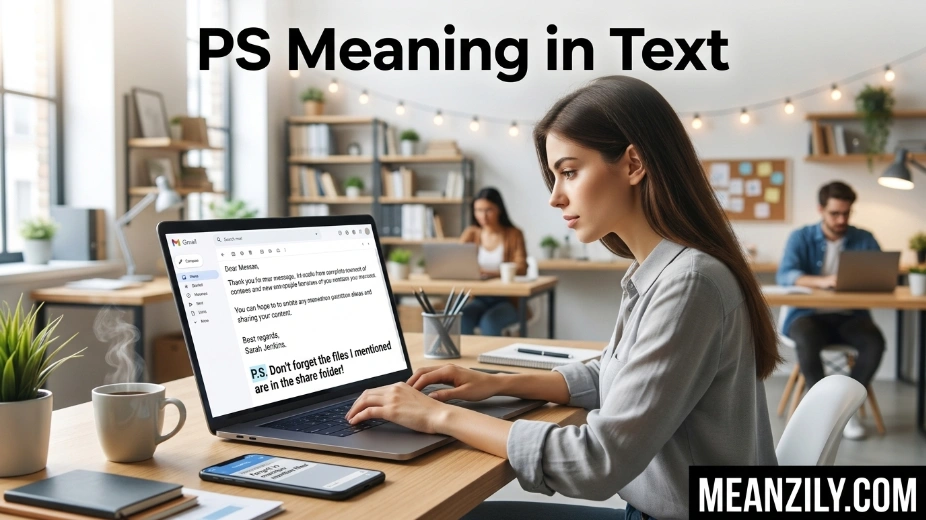
The meaning of PS in text is “postscript.”
A postscript is an extra message added after you finish writing something. The abbreviation comes from Latin “post scriptum,” which means “written after.”
In modern texting, PS is used to:
- Add an extra thought after sending a message
- Emphasize something important
- Include something you forgot earlier
- Add a funny or emotional final note
Is PS slang or an acronym?
PS is not exactly slang. It is an abbreviation (or short form) that comes from formal writing. However, online it behaves like casual internet language.
Everyday meaning in chat
In daily texting, PS usually feels like:
- “Oh wait, one more thing…”
- “I forgot to mention this…”
- “Before I forget…”
It gives messages a natural, conversational ending.
Where People Use PS
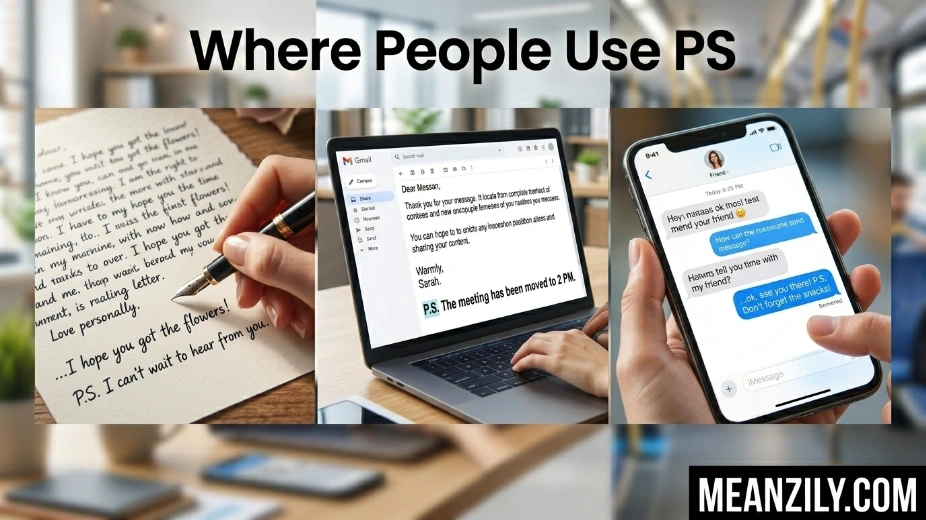
PS is used across many platforms because it fits naturally at the end of messages.
TikTok
On TikTok, PS is often used in captions or comments:
- To add a final joke
- To give extra context
- To add a personal note after a story
Example:
“Had the best day ever 😭 PS: I lost my phone twice today”
Snapchat
On Snapchat, PS appears in:
- Chat messages
- Story captions
People use it to add last-minute thoughts before sending snaps.
On Instagram, PS is very common in captions:
- After long captions
- At the end of emotional posts
- In funny or relatable content
Example:
“Grateful for this trip ❤️ PS: I never want to come back home”
On WhatsApp, PS is widely used in daily conversations:
- To add forgotten info
- To send reminders
- To clarify something after sending a message
SMS (Text Messages)
PS originally became popular in SMS texting because:
- People couldn’t edit messages easily
- They often forgot things after sending
So they simply added “PS” in a second message.
Real Chat Examples
Here are 10 real-life texting examples showing how PS is used naturally:
Example 1
A: I had a great time today
B: Same here!
A: PS: You still owe me coffee ☕
2
A: Don’t forget the meeting tomorrow
B: Got it
A: PS: It starts at 10 AM sharp
3
A: I’m going offline now
B: Okay, bye
A: PS: Check your email later
4
A: That movie was amazing
B: Totally agree
A: PS: The ending made me cry
5
A: I’ll call you later
B: Sure
A: PS: Don’t ignore my call 😭
6
A: Thanks for helping me
B: No problem
A: PS: I really appreciate it
7
A: I’m home now
B: Safe?
A: PS: I almost missed the bus twice
8
A: Happy birthday!
B: Thank you!
A: PS: Your gift is on the way 🎁
9
A: I finished my homework
B: Nice
A: PS: It took forever
Example 10
A: See you tomorrow
B: Yup
A: PS: Bring snacks 😂
How to Reply When Someone Says “PS”
When someone uses PS in a message, your reply depends on tone.
Funny replies
- “PS: I saw that coming 😭”
- “Not the PS reveal 😂”
- “You always have a PS!”
Casual replies
- “Okay noted 👍”
- “Got it, thanks”
- “Haha alright”
Friendly replies
- “Thanks for letting me know 😊”
- “Good to know!”
- “I appreciate it”
Neutral replies
- “Okay.”
- “Understood.”
- “Noted.”
The key is to respond naturally based on the context of the message, not the PS itself.
Is PS Rude or Offensive?
No, PS is not rude or offensive.
It is a neutral expression used in writing and texting. It simply means “extra information added after the main message.”
Is it safe to use?
Yes, it is completely safe in:
- School chats
- Work emails
- Social media posts
- Casual texting
Is it appropriate at work or school?
Yes, but with limits:
- In formal emails, PS is acceptable but should be used carefully
- In casual school chats, it is very common
- In professional writing, it may look informal but still acceptable
Overall, PS is polite and widely understood.
Who Uses This Term?
PS is used by almost everyone, but especially:
Age groups
- Teenagers (13–19)
- Young adults (20–35)
- Office workers in emails
Gen Z usage
Gen Z uses PS frequently in:
- TikTok captions
- Instagram posts
- WhatsApp chats
They use it mostly for humor or emotional expression.
Platforms
- TikTok
- Snapchat
- SMS
How often it appears online
PS is moderately common. It is not trending slang, but it is consistently used in digital communication.
Origin of the Term
The origin of PS (postscript) is actually very old.
Historical origin
- Comes from Latin: post scriptum
- Used in handwritten letters before digital communication
How it became popular online
When texting and emails became common:
- People couldn’t easily edit messages
- So they reused “PS” to add extra thoughts
Internet culture influence
Social media made PS more casual:
- It became part of captions
- It is now used humorously or emotionally
Is the origin clear?
Yes, the origin is very clear and well-documented. It is not internet-made slang.
Comparison Table
| Term | Meaning | Type | Usage | Popularity |
|---|---|---|---|---|
| PS | Postscript (extra note after message) | Abbreviation | Adding extra thoughts | Medium |
| IDK | I don’t know | Acronym | Expressing uncertainty | High |
| IDC | I don’t care | Acronym | Showing indifference | High |
| IMO | In my opinion | Acronym | Giving opinions | High |
| BRB | Be right back | Acronym | Temporary leave in chat | Medium |
Real-World Usage Example
Imagine you are texting your friend after a school day:
You send:
“Today was fun, we should hang out again.”
Then you remember something and add:
“PS: Don’t forget to bring my notebook tomorrow.”
This shows how PS helps you add extra information without rewriting the whole message.
It makes texting faster, smoother, and more natural.
Why People Still Use PS in 2026
Even with emojis, voice notes, and edited messages, PS is still popular in modern chats.
One reason is habit. People grew up seeing it in emails and messages, so it naturally stayed in digital communication.
Another reason is tone. PS feels personal. It sounds like you’re adding a little whisper at the end of your message, which makes conversations feel more human.
Also, it’s quick. Instead of rewriting a whole message, you just add “PS:” and continue.
Psychological Effect of Using PS in Messages
PS isn’t just a writing habit — it also changes how a message feels.
When someone adds PS, it often:
- Makes the message feel more personal
- Adds emotional weight to the last point
- Creates curiosity (“What else did they want to say?”)
- Makes casual messages feel warmer
For example:
“Goodnight 😊 PS: I really enjoyed talking to you today”
That small extra line can completely change the emotional tone of the message.
Common Mistakes People Make With PS
Even though PS is simple, people still use it in slightly wrong ways.
Some common mistakes include:
- Adding too many PS lines (PS, PS2, PS3…)
- Using it in every single message
- Writing long paragraphs after PS (it should be short)
- Confusing it with “P.S. means problem solved” (this is wrong in texting context)
The best way to use PS is simple: one short extra thought at the end.
PS in Professional Emails vs Casual Chats
PS behaves differently depending on where you use it.
In professional emails:
It is used carefully and politely.
Example:
“Please find the report attached.
PS: Let me know if you need any changes.”
In casual chats:
It is more relaxed and emotional.
Example:
“Had a great day! PS: I’m so tired now 😂”
So the same term can feel formal or informal depending on the situation.
How PS Changes the Flow of a Conversation
PS often acts like a “soft ending” to a message.
Instead of stopping abruptly, it allows people to:
- Continue thoughts naturally
- Add forgotten details
- Extend emotional expression
Without PS, messages can sometimes feel too final or incomplete. With PS, they feel more conversational, like real speech.
Cultural Influence of PS in Internet Communication
PS is one of those rare terms that survived from old writing culture into modern internet slang.
In older times, it was used in handwritten letters. Today, it exists in:
- memes
- captions
- online storytelling
- casual texting
It’s interesting because many old writing habits disappeared, but PS stayed because it still fits perfectly in modern communication style.
When NOT to Use PS
Even though PS is harmless, there are situations where it doesn’t fit well.
Avoid using PS when:
- Writing legal documents
- Sending official government applications
- Creating academic essays
- Writing structured reports
In these cases, messages should be complete and properly structured without add-on notes.
PS is best for informal and semi-formal communication only.
Why PS Feels More Personal Than Editing a Message
Modern apps allow editing messages, so you might wonder: why not just edit instead of using PS?
The answer is tone.
Editing hides the thought process. PS shows it.
When you use PS, it feels like:
- “I just remembered something”
- “I wanted to tell you one more thing”
This makes conversations feel more human and less robotic.
Digital Evolution of PS in Modern Chat Culture
Over time, PS has evolved from formal writing into a casual digital tool.
It now appears in:
- short jokes at the end of captions
- emotional confessions
- playful reminders
- sarcastic comments
Its meaning hasn’t changed, but its usage has become more flexible and creative.
Today, PS is less about writing rules and more about personality.
Quick Tip: How to Use PS Naturally in Your Own Messages
If you want to use PS like a native internet user, keep it simple.
Just remember:
- Use it at the end of a message
- Keep it short and meaningful
- Don’t overuse it
- Use it when you genuinely have an extra thought
Example:
“See you tomorrow! PS: bring snacks 😄”
That’s it — simple and natural.
Why “PS” Still Works Better Than Emojis in Some Cases
Even though emojis are everywhere, PS still has a different impact in messages.
Emojis show emotion instantly, but PS feels more like a spoken thought. It adds meaning in words instead of symbols.
For example:
“I miss you ❤️”
vs
“I miss you. PS: It’s been a really long week without talking to you.”
The second version feels more personal and detailed. That’s why some people still prefer PS when they want their message to feel a little more meaningful.
Difference Between PS and “BTW” in Chat Conversations
People often confuse PS with BTW (by the way), but they are not exactly the same.
- PS is used at the end of a message
- BTW is usually used in the middle or beginning of a sentence
PS feels like a final thought, while BTW feels like a side topic.
Example:
“I’ll call you later. PS: Don’t forget the file.”
vs
“BTW, did you finish the file?”
So PS is more like a closing note, while BTW is more like a conversation shift.
How PS Helps Make Messages Sound More Natural
One interesting thing about PS is that it makes written messages feel closer to real speech.
When people talk in real life, they often remember things after finishing a sentence. PS copies that behavior in texting.
Instead of editing or deleting messages, users just add:
“PS: one more thing…”
This creates a natural flow that feels like someone thinking out loud rather than writing perfectly structured sentences.
Situations Where PS Adds Humor to Messages
PS is often used to make messages funny without trying too hard.
People use it to:
- add sarcastic comments
- make jokes after serious statements
- surprise the reader at the end
Example:
“I’m going to sleep early today. PS: It’s already 2 AM 😭”
The humor comes from the contrast between the main message and the PS line.
Why PS Is Easy for Beginners to Understand
Unlike many internet slang terms, PS is very beginner-friendly.
There are no hidden meanings or complicated interpretations. Once you know it means “extra note,” you can understand it in any context.
That simplicity is why:
- kids can use it
- adults understand it easily
- it works across cultures
PS doesn’t require deep internet knowledge, which makes it universal.
How PS Is Used Differently in Long vs Short Messages
PS behaves differently depending on message length.
In long messages:
It is used to add final thoughts or summaries.
Example:
“Had an amazing trip, met so many people, and learned a lot. PS: I don’t want to come back.”
In short messages:
It is often used for quick reminders.
Example:
“Meet me at 5. PS: don’t be late.”
So its role adapts depending on how much information is already shared.
The Role of PS in Emotional Texting
PS is often used when people want to express feelings they didn’t include earlier.
It helps add emotional depth without rewriting the whole message.
Example:
“Take care of yourself. PS: I really mean it.”
This small addition can make messages feel warmer, more caring, and more sincere.
That’s why PS is popular in friendships and relationships.
Why PS Is Not the Same as Modern Chat Abbreviations
Many chat terms like LOL, BRB, or OMG are part of internet slang culture.
But PS is different because:
- it comes from old writing tradition
- it is not based on internet trends
- it works in both formal and informal writing
This makes PS more timeless compared to fast-changing slang words.
How PS Is Used in Storytelling on Social Media
On platforms like Instagram and TikTok, PS is often used in storytelling captions.
People write long emotional or funny stories and then end with a PS line to add surprise or personality.
Example:
“Today I finally achieved my goal after months of struggle. PS: I almost gave up yesterday.”
This structure keeps readers engaged until the last line.
Why PS Is Still Taught in Writing Basics
Even in some English writing lessons, PS is still mentioned because it shows how communication evolved.
It teaches students:
- how to add extra notes
- how letters used to be written
- how modern texting developed from traditional writing
So PS is not just internet language — it is also part of writing history.
How PS Makes Conversations Feel Less Formal
One reason PS is popular in texting is because it breaks formality.
Instead of strict sentence structure, it adds a relaxed tone.
Compare:
“I would like to remind you about the meeting.”
vs
“Don’t forget the meeting. PS: it starts at 10.”
The second one feels more friendly and less strict.
How Context Changes the Meaning of PS in Conversations
Even though PS has one basic meaning, the way people interpret it can change depending on the situation.
In a light chat, PS may feel funny or casual. In an emotional message, it can feel serious or thoughtful. The surrounding words decide the tone.
For example:
“PS: I was joking 😂” feels playful
“PS: I needed to say this before it was too late” feels emotional
So PS is flexible—it adapts to the mood of the conversation instead of having a fixed emotional value.
Why People Often Add PS After Sending a Message
A very common habit is using PS immediately after pressing send. This usually happens because people forget something important or think of a better point too late.
Instead of deleting or rewriting the message, they simply add a second message starting with PS.
This habit comes from natural human thinking patterns. We rarely express everything perfectly in one go, especially in fast texting conversations.
The Subtle Etiquette of Using PS in Friendly Chats
There is an unspoken “etiquette” when using PS in casual communication.
Good usage feels natural and brief. Overusing it can make messages look cluttered or overly dramatic.
In friendly chats, PS works best when:
- it adds a small extra detail
- it feels spontaneous
- it doesn’t repeat what was already said
This keeps conversations smooth and easy to read.
How PS Appears in Online Memes and Humor Culture
PS has also found its place in internet humor. Meme creators often use it to deliver punchlines or unexpected twists at the end of a post.
A meme might look normal at first, and then the PS line changes the entire meaning.
For example:
“Finally started exercising. PS: walked to the fridge three times today.”
This structure makes PS a useful tool for surprise humor.
The Relationship Between PS and Human Memory Patterns
PS works closely with how the human brain naturally remembers things.
People often:
- forget details while speaking or texting
- recall them right after finishing
- want to add them without restructuring the message
PS solves this perfectly by acting like a “mental add-on button.” It mirrors real thinking behavior in written form.
Why PS Feels More Authentic Than Editing Messages
When someone edits a message, it feels polished and corrected. But PS feels raw and real.
It shows the exact moment a person remembered something. That creates a sense of authenticity.
Instead of hiding mistakes or gaps, PS openly shows that the message is still “in progress,” which makes conversations feel more human and less artificial.
The Role of PS in Building Stronger Digital Communication
Small writing habits like PS actually improve how people connect online.
It helps:
- keep conversations flowing naturally
- reduce pressure to write perfect messages
- add personality to text-based communication
These small touches make digital conversations feel closer to real-life interaction.
How Different Generations Interpret PS in Texting
Not everyone sees PS the same way.
Older generations often understand it as a formal writing term from letters or emails. Younger users treat it more casually as part of texting culture.
Despite this difference, both groups still interpret it correctly, which is why PS remains widely understood across age groups.
Why PS Rarely Causes Misunderstanding in Chats
Unlike many slang terms, PS is very clear and rarely misunderstood.
The reason is simple: its meaning is direct and context-independent.
Even if someone has never seen it before, they can usually guess it means “extra note” just by reading the sentence. This makes it one of the safest expressions in online communication.
How PS Can Improve Story Flow in Personal Messages
In storytelling-style messages, PS can act like a closing twist or final reflection.
It helps writers:
- add emotional depth at the end
- include a hidden thought
- give a final comment that changes tone
This makes personal messages more engaging and expressive, especially in long conversations.
The Quiet Influence of PS on Modern Digital Writing Style
Even though PS is small, it has influenced how people write online.
It encouraged the habit of:
- adding side notes in messages
- breaking thoughts into smaller parts
- writing more conversationally
This influence can be seen in captions, tweets, and casual emails everywhere today.
Frequently Asked Questions
What does PS mean in text messages?
PS means “postscript,” an extra message added after the main text.
What does PS mean on TikTok?
On TikTok, PS is used in captions or comments to add extra thoughts or jokes.
Is PS slang?
No, PS is not slang. It is an abbreviation from formal writing.
Is PS rude or offensive?
No, PS is neutral and safe to use in all types of conversations.
How should you reply to PS?
You can reply casually like “okay,” “got it,” or react depending on the message tone.
Conclusion
PS in texting simply means “postscript,” which is an extra note added after a message is already written. People use it when they want to add something they forgot or emphasize a final thought.
It is commonly seen on WhatsApp, TikTok, Instagram, Snapchat, and SMS messages. It is not slang, not rude, and not confusing once you understand its purpose.
You should use PS when you want to add extra information casually, but avoid overusing it in formal writing like professional documents.
Overall, PS is a simple and useful part of digital communication that helps make conversations feel more natural and human.
Discover More Post
What Does Degenerate Mean Online? Slang Uses Replies .
What Does Wolf Meaning in Text? Slang Guide with Examples …
..What Does ASF Mean in Text? Real Meaning Examples …

Roam is an SEO specialist and digital content strategist with over 7 years of hands-on experience in search engine optimization, keyword research, and content marketing. He helps brands grow their online visibility through data-driven SEO strategies and high-quality, user-focused content. As the founder of Meanzily, Roam is passionate about delivering actionable insights that rank on Google and provide real value to readers. His expertise spans on-page SEO, technical optimization, and authority-building content designed for long-term organic growth.